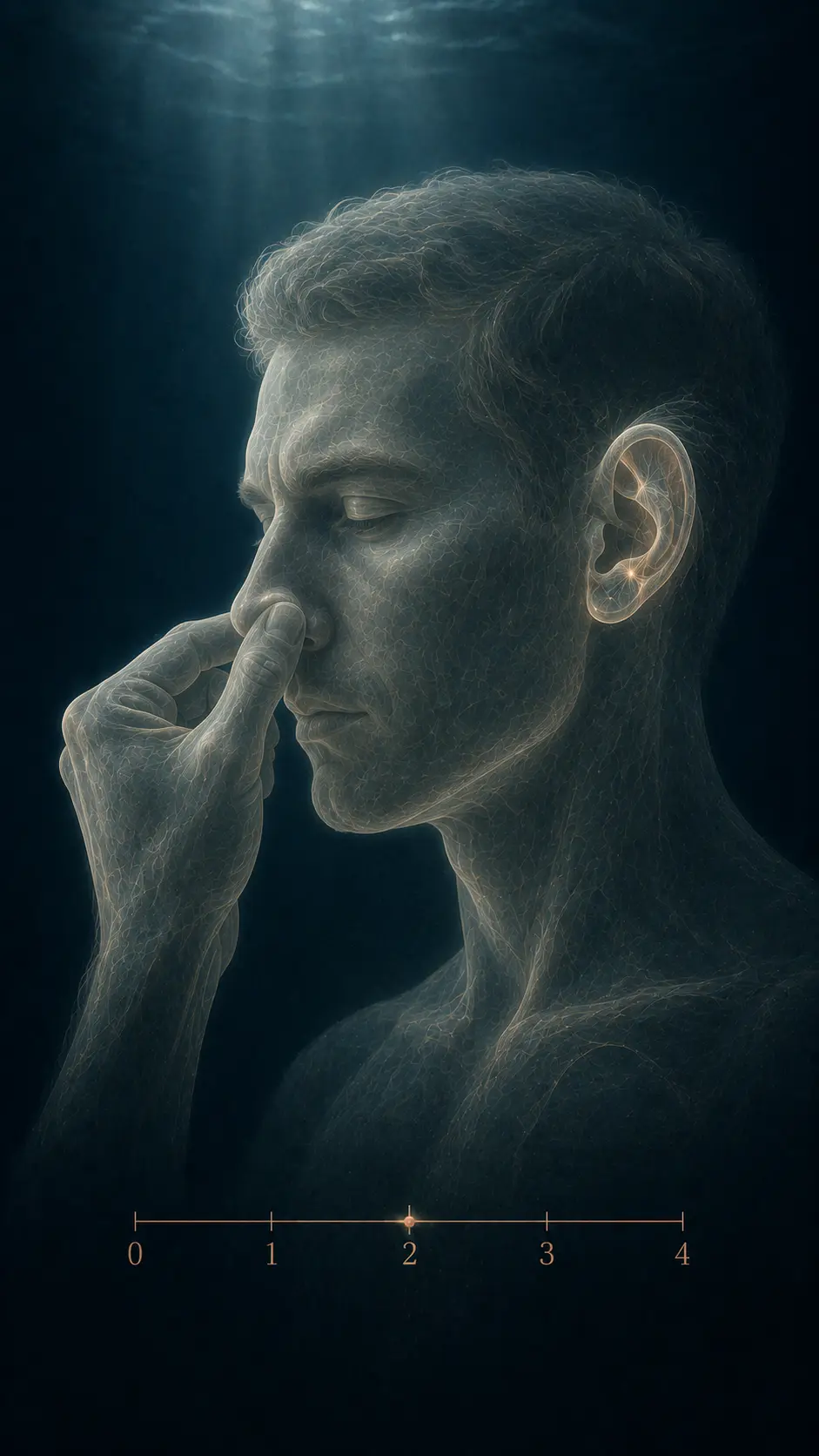
From private sensation to shared language
Giunta and colleagues proposed an Equalization Problems, or EP, score running from 0 for normal equalization to 4 for inability to equalize. They applied it to 40 Italian freediving spearfishers: 20 with recurrent difficulty or repeated barotrauma despite being symptom-free at normal pressure, and 20 healthy divers without such a history. The symptomatic group had undergone Eustachian-tube balloon dilation after previous treatment—including nasal surgery in some cases—had not solved the problem. Baseline scores separated the groups, and the authors reported that successfully treated patients later resembled healthy comparators.
Why a score is attractive
Equalization trouble is intermittent, technique-dependent and often absent in the clinic. A simple ordinal scale can preserve what happened at depth, support follow-up and give diver and clinician a common vocabulary. That is especially useful when an otoscopic examination between dives looks normal. A score may also prevent the vague phrase “my ears were difficult” from flattening important differences between delay, force, pain and complete failure.
Validation has barely begun
This paper is a proposal, not a mature diagnostic instrument. The small, highly specific cohort combined symptom classification with an intervention series. The accessible report does not provide independent replication, inter-rater or test–retest reliability, sensitivity, specificity, a minimal important change, blinded comparison with objective pressure testing, or evidence that the categories predict injury. One abstract statement is internally inconsistent: it describes no post-treatment difference while printing a p-value below 0.05, which would conventionally indicate statistical significance. That reporting problem should be resolved from the authors' data before the result is used quantitatively.
The editorial reading
The EP score is best treated as structured history: a way to document a dive and observe change over time. It should not diagnose Eustachian-tube dysfunction by itself, justify surgery, or grant permission to continue through pain. A stronger next study would predefine each level, test whether different observers agree, compare it with objective measures, and follow future barotrauma. Until then, the score is a promising sentence starter—not the final word from the ear.
Safety note: This is educational analysis, not individualized medical advice or a maximal-training protocol. In-water practice requires trained safety and current standards.
Original conceptual editorial illustration created for this Journal.