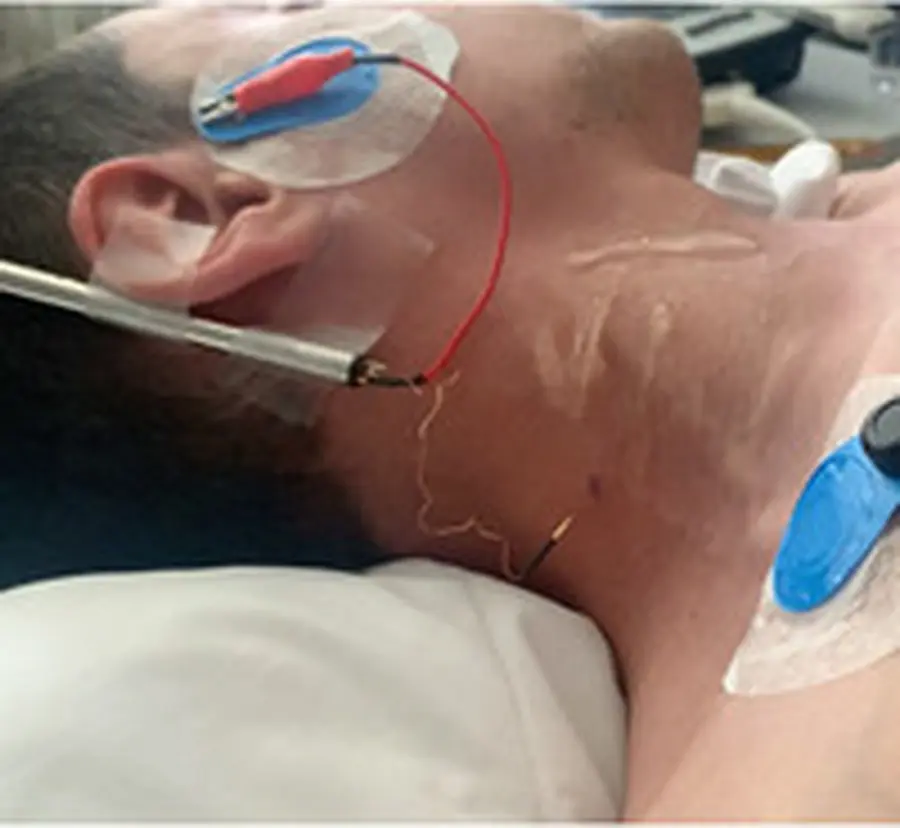
A rare human recording
Macefield and colleagues used ultrasound guidance to place a sterile tungsten microelectrode percutaneously into the right cervical vagus nerve. Multi-unit neural traffic, ECG and respiratory signals were recorded in 10 trained male breath-hold divers and 10 successful control recordings. Participants completed tidal breathing, slow deep breathing, 40-second breath-holds at inspiratory capacity and end expiration; the trained divers also performed a maximal end-inspiratory breath-hold, analysed during its quiet phase and after involuntary breathing movements began. Cross-correlation estimated how strongly neural activity was modulated by the cardiac and respiratory cycles.
The expected difference did not appear
The researchers expected trained divers to show greater cardiac modulation of vagal activity, particularly during maximal apnoea. They did not. Cardiac modulation was similar between groups during ordinary breathing and the standardized manoeuvres, and it did not change meaningfully between the static and involuntary-movement phases of the divers' maximal breath-holds. Respiratory modulation was generally stronger than cardiac modulation, yet likewise showed no clear group distinction. The authors therefore conclude that altered sensory input from the heart, as captured by this method, does not explain elite tolerance of asphyxia.
A precise negative, within a narrow window
This is not evidence that the vagus is unimportant, that parasympathetic output never changes, or that the brain has no role in the dive response. Multi-unit recordings mix axons, and cardiac modulation mainly reflects afferent traffic rather than a clean measure of outgoing vagal command. Recordings came only from the right cervical nerve and varied substantially by electrode site. The groups were small and not well age- or sex-matched; controls were younger and did not perform maximal apnoea. The experiment was supine and dry, without facial immersion, hydrostatic pressure, descent, exercise or ascent. One hypertensive diver and one vasovagal event also underscore the difficulty of this invasive protocol.
The editorial reading
Elite breath-hold capacity is unlikely to reside in a single wire carrying a larger signal. A negative finding trims the map: it moves attention toward central control, integrated chemoreflexes, blood distribution, oxygen stores, learned attention and their interaction. The study's courage is methodological, not performative. It listened directly and found that a seductive explanation was insufficient. That is how physiology becomes more precise.
Safety note: This is educational analysis, not individualized medical advice or a maximal-training protocol. In-water practice requires trained safety and current standards.