Eight systems, one dive
Paganini and colleagues searched PubMed and Scopus in early 2025, screened 381 records, identified 187 unique papers and selected 161, later adding five recent studies. They organize 166 publications across cardiovascular, pulmonary, neurological, decompression, muscle and metabolic, training, long-term and telemonitoring themes. The integrated view is the review's strength: bradycardia, peripheral vasoconstriction, blood shift, gas exchange, spleen, brain perfusion, lung mechanics and learning do not happen in isolation.
The field's clearest advances
Research has moved from dry static apnoea toward arterial sampling, echocardiography, ultrasound, near-infrared spectroscopy and field-capable sensors in real water. The review shows how descent and ascent produce different oxygen landscapes; why blood shift protects against compression yet adds pulmonary vascular load; how lung squeeze, haemoptysis, blackouts and neurological decompression events remain clinically important; and how adaptations may coexist with maladaptations. It also catalogues large individual variability and the influence of temperature, technique, lung volume and environment.
A map is not a measurement standard
This is a state-of-the-art narrative review, not a systematic review with exhaustive inclusion, formal risk-of-bias grading or meta-analysis. Papers were selected by author consensus for influence and relevance, restricted to English-language human work, and included case reports. The underlying literature is highly heterogeneous and often small. Elite athletes dominate some questions, while women, older divers, beginners and occupational communities remain underrepresented. Training studies are frequently short; long-term health data are sparse; and telemonitoring has not yet validated an algorithm that predicts an adverse event in time to prevent it.
The editorial reading
The review does not reveal a single human limit. It shows a moving boundary produced by physiology, environment, technique, selection and culture—and it reveals where uncertainty concentrates. The field now needs multicentre protocols, shared outcome definitions, more representative cohorts, complete descent-to-recovery measurements and reporting of uneventful dives as well as accidents. Technology should be judged by clinical or safety outcomes, not only by the beauty of a live trace. The science is maturing when it becomes less impressed by records and more exact about ordinary bodies under pressure.
Safety note: This is educational analysis, not individualized medical advice or a maximal-training protocol. In-water practice requires trained safety and current standards.
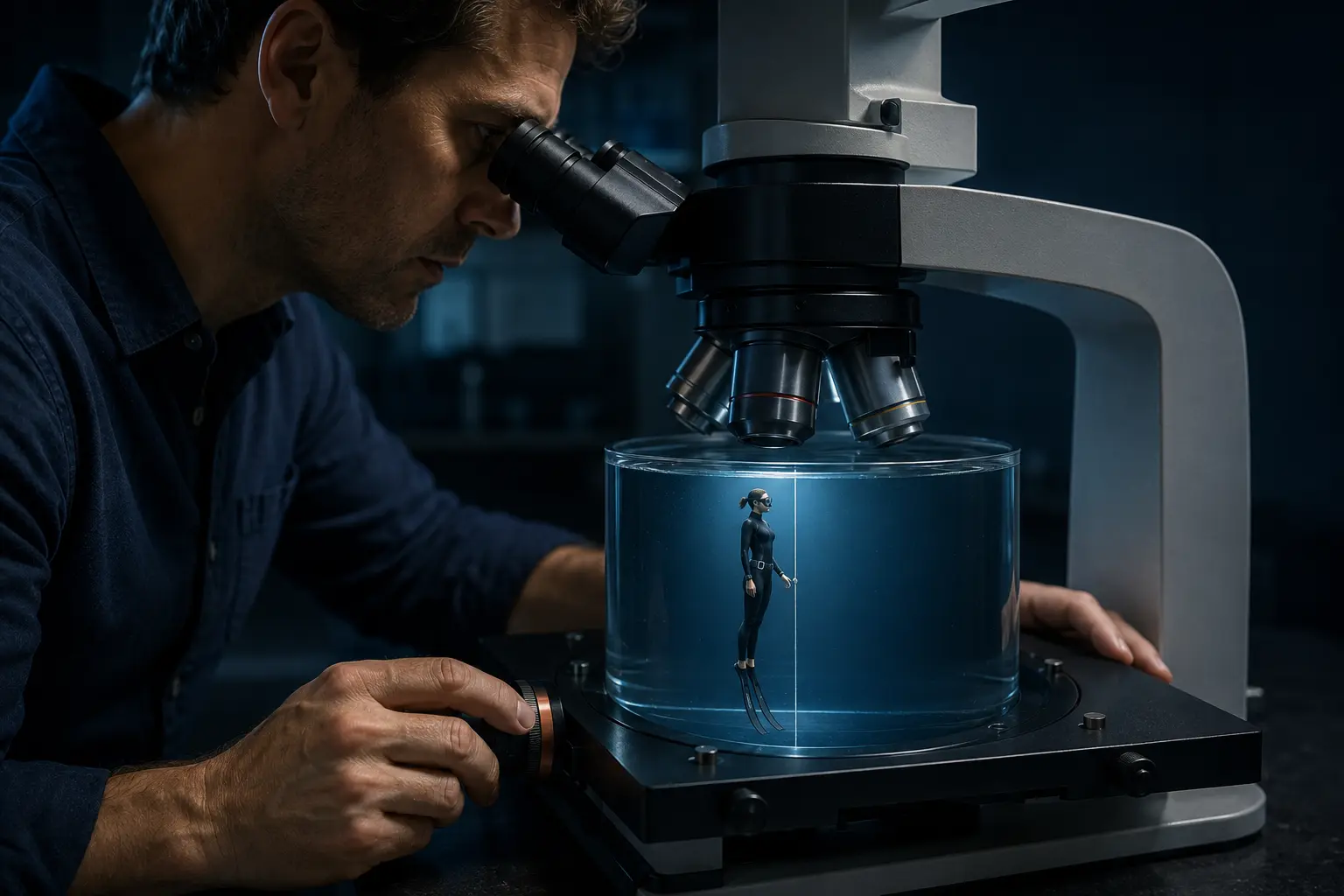
Original conceptual editorial illustration created for this Journal; it is not a literal research procedure.